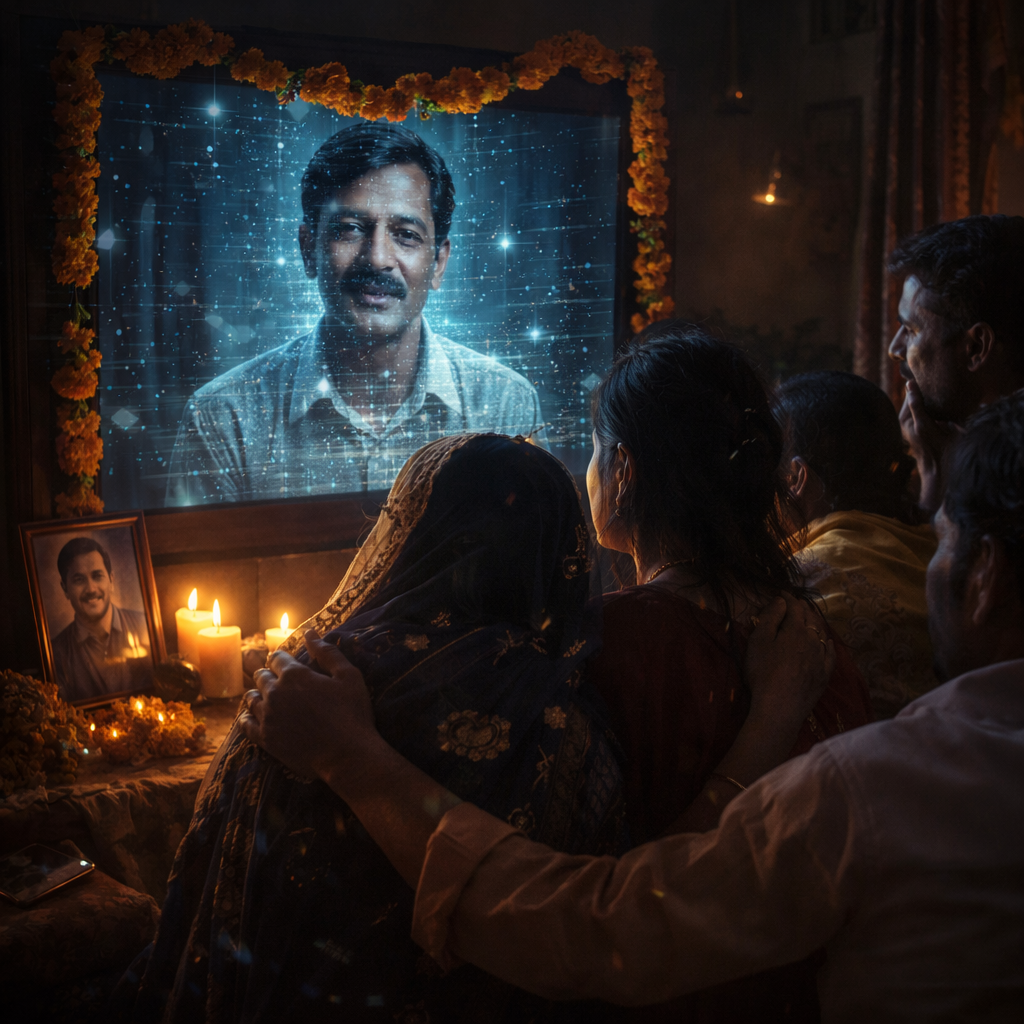
In a quiet hall filled with mourning relatives, a screen flickers to life.
A man appears.
He smiles gently.
He begins to speak.
The room falls silent.
Because the man speaking died weeks ago.
Across parts of India, families are turning to AI deepfake technology to recreate the faces and voices of loved ones who have passed away. At memorial ceremonies, these digital recreations deliver messages, blessings, or final words to the living.
For some, the experience brings comfort.
For others, it feels like something darker—an unsettling fusion of technology and grief.
And it raises a question humanity has never faced before:
What happens when the dead can still address the living?
When the Dead Appear Again on Screen
Funeral rituals have always centered on memory.
Stories are told.
Photographs are displayed.
Voices of the living remember the absent.
But in some Indian memorial gatherings today, the deceased appear to speak again—not through memory, but through artificial intelligence.
The Emergence of AI Deepfakes in Memorial Rituals
Video production studios and AI specialists are now offering services that recreate deceased individuals using deepfake technology.
By combining video editing, facial mapping, and voice cloning, these teams produce short clips where the dead appear to deliver personal messages to family members.
According to reporting from Rest of World, some Indian families have begun showing these videos during mourning ceremonies and remembrance events.
The impact can be powerful.
Seeing a loved one move, smile, and speak again—even digitally—can feel almost miraculous.
But miracles created by machines rarely come without consequences.
Why the Practice Is Growing in India
India’s strong cultural traditions around remembrance and ancestral respect make the technology especially resonant.
In many communities, memorial ceremonies focus heavily on:
- blessings for the family
- final words from elders
- honoring the legacy of the deceased
Deepfake technology allows families to simulate those final messages.
But that simulation blurs the line between tribute and imitation.
Understanding AI Deepfakes in Grief Ceremonies
Before exploring the emotional effects, it helps to understand the technology itself.
What Are AI Deepfakes?
A deepfake is a synthetic media creation where artificial intelligence replaces or generates a person’s face or voice in a video.
These systems rely on deep learning models that analyze large amounts of visual and audio data.
With enough examples, AI can recreate:
- facial expressions
- lip movements
- voice tone and speech patterns
The result is a video where a person appears to say things they never actually said.
From Film Technology to Funeral Rituals
Deepfake tools were originally developed for film production and visual effects.
Hollywood used similar techniques to recreate actors or de-age characters.
But over time, the technology became cheaper and more accessible.
Now it is used in:
- social media videos
- political misinformation
- entertainment
And increasingly, memorial tributes.
The transition from entertainment technology to mourning rituals has happened surprisingly fast.
How Deepfake Memorial Videos Are Created
Behind the emotional impact of these videos lies a surprisingly technical process.
Collecting Photos, Videos, and Voice Recordings
The first step involves gathering as much media of the deceased as possible.
Families provide:
- photographs
- home videos
- voice recordings
- social media clips
This material forms the dataset used to train AI models.
The more data available, the more convincing the deepfake becomes.
Training AI to Recreate a Person’s Face and Speech
AI software analyzes facial structures and speech patterns from the collected media.
Machine learning algorithms then generate new footage that mimics how the person moved and spoke.
The result is a digital reconstruction capable of appearing in newly generated videos.
Editing Messages from the Deceased
Once the digital model exists, editors create scripts for the message.
The AI-generated face then performs those lines on screen.
In many cases, the content includes:
- blessings to family members
- messages of gratitude
- reflections on life
But the words are not truly from the deceased.
They are written by the living.
And that subtle difference changes everything.
Why Families Choose Deepfake Messages
Despite the unsettling nature of the technology, many families choose it for deeply human reasons.
Cultural Importance of Final Words
In many cultures, final messages from elders carry enormous emotional weight.
They provide:
- closure
- guidance
- reassurance for the future
When death comes suddenly, those words may never be spoken.
Deepfake memorials attempt to fill that silence.
Emotional Closure Through Technology
For grieving relatives, seeing a loved one speak again—even digitally—can feel comforting.
It offers a brief illusion that the person is still present.
But emotional closure created by simulation may come with hidden psychological costs.
The Ethical Shadows Behind AI Deepfakes
As the technology spreads, ethical questions grow louder.
Consent and Digital Resurrection
One major concern is consent.
Did the deceased agree to be recreated with artificial intelligence?
In most cases, the answer is no.
Their images and voices are used after death without explicit permission.
This raises serious questions about digital identity and personal rights.
The Risk of Manipulated Memory
Deepfake memorials also shape how the deceased are remembered.
If the AI version says things the real person never said, the technology may slowly alter collective memory.
Over time, families might remember the AI performance more clearly than the real person.
Memory itself becomes editable.
Psychological Effects of Seeing the Dead Speak Again
The human brain is not designed for interactions like this.
Comfort or Emotional Disturbance?
Some mourners report comfort from these videos.
Others feel something closer to unease.
Watching someone who has died suddenly appear alive on a screen can trigger what psychologists call the uncanny effect—the disturbing sensation of encountering something almost human but not quite.
The Uncanny Valley of Digital Humans
When AI recreations look realistic but imperfect, they can feel eerie or unsettling.
Subtle errors in movement or expression remind viewers that the person they see is not truly alive.
The result is a strange emotional conflict.
Part of the mind recognizes the illusion.
Another part desperately wants to believe it.
The Future of Mourning in the Age of AI
The experiments happening in India may only be the beginning.
Technology Entering Sacred Rituals
For centuries, mourning rituals remained largely unchanged.
Now artificial intelligence is entering those traditions.
Screens, algorithms, and synthetic voices may soon become part of memorial ceremonies worldwide.
The Possibility of Permanent Digital Ancestors
If technology continues advancing, memorial videos could evolve into interactive avatars.
Future generations might speak with digital recreations of ancestors long after their deaths.
The line between memory and simulation would disappear entirely.
And humanity would face a strange new reality:
A world where the dead never fully leave.
FAQs
1. What is a deepfake memorial video?
A deepfake memorial video uses AI to recreate the face and voice of a deceased person, allowing them to appear as if they are speaking in a newly generated message.
2. Are these videos common in India?
The practice is still emerging, but some families and media studios have begun using the technology in memorial ceremonies.
3. How accurate are deepfake recreations?
With enough source material, AI can produce highly realistic videos, though subtle imperfections may still appear.
4. Do deepfake memorials require consent from the deceased?
In most cases, consent is not formally obtained, raising ethical concerns about digital identity.
5. Can deepfake technology harm memory of the deceased?
Yes. Experts warn that AI-generated messages could distort how people remember the person over time.
6. Will AI mourning technologies become more common?
As AI tools become cheaper and more powerful, digital memorials are likely to become more widespread globally.
Conclusion
Grief has always been one of the most deeply human experiences.
It reminds us that life is temporary.
That absence is real.
But technologies like deepfake memorials are beginning to rewrite that experience.
They allow the dead to speak again—not through memory, but through algorithms.
For some families, that illusion offers comfort.
For others, it opens a door that may be difficult to close.
Because once technology learns to resurrect voices and faces, the silence of death may never feel quite the same again.