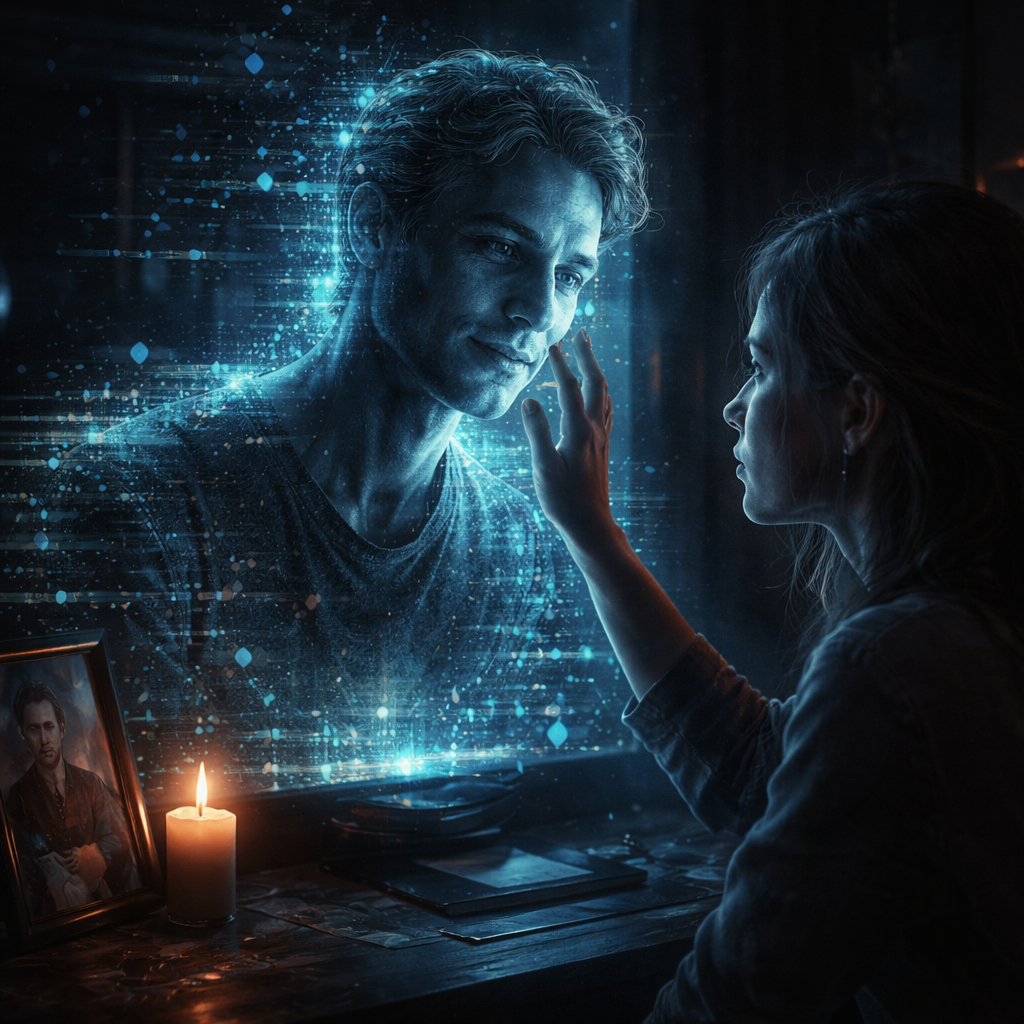
The idea once belonged to horror stories.
A voice in the dark.
A message from someone who should no longer exist.
Today, that voice might come from your phone.
Across the world, engineers and startups are building something known as Deadbots—AI systems trained on the data of people who have died. They promise something extraordinary: the ability to talk with the dead again.
At first glance, it sounds comforting.
But beneath that promise lies a strange and unsettling question:
What happens when technology refuses to let death be final?
The Day the Dead Started Talking Again
Grief has always followed a single rule.
The living remember.
The dead remain silent.
Artificial intelligence is beginning to break that rule.
In recent years, developers have started building AI systems that recreate the speech patterns, personality traits, and memories of people who are gone. These digital replicas are often called deadbots, griefbots, or digital ghosts.
Using vast archives of messages, emails, videos, and social media posts, AI can simulate how a person might speak or respond.
The result is unsettling.
You type a message.
And a machine answers you in the voice of someone who died years ago.
What Are Deadbots?
A deadbot is an artificial intelligence model trained on the digital remains of a deceased person.
It may appear as:
- A chatbot that mimics their texting style
- A voice assistant speaking with their voice
- A digital avatar that moves and speaks on screen
These systems rely on machine learning and natural language processing to recreate a person’s personality and conversational habits.
The goal is simple.
Preserve a person so convincingly that interacting with them feels real.
But there is a darker implication hidden in that goal.
The Data That Survives Us
Human beings leave behind more than memories.
We leave data.
- Emails
- Text messages
- Voice notes
- Social media posts
- Photos and videos
Together, these fragments form a digital shadow of our lives.
For AI systems, that shadow is enough to reconstruct something that looks disturbingly like a person.
Not the real person.
But something close enough to fool the grieving mind.
The Rise of Digital Resurrection
Not long ago, the concept of resurrecting someone digitally sounded impossible.
Today, it is becoming a business model.
Several startups now offer services that allow people to create interactive AI versions of loved ones who have died. Some companies gather recordings, interviews, and personal data to build what they call “posthumous personas.”
In other words:
They build a digital afterlife.
Startups Selling Immortality
One example described in reporting by The Atlantic tells the story of an entrepreneur who attempted to recreate his deceased mother using artificial intelligence.
To do it, he collected videos, interviews, and conversations—feeding them into an AI system designed to simulate her personality.
The vision behind projects like this is striking:
Grief could become optional.
Loss could become reversible.
Death might simply become another technical limitation waiting to be solved.
From Memorials to Interactive Ghosts
Human beings have always preserved memories of the dead.
Paintings.
Photographs.
Letters.
But those things never talked back.
Deadbots do.
Unlike traditional memorials, AI recreations can produce new sentences, new reactions, and new stories, all while pretending to be someone who no longer exists.
This is the moment where memory crosses a dangerous boundary.
It stops being remembrance.
And becomes simulation.
How Deadbots Are Created
Building a digital ghost is not magic.
It is data science.
And the process is surprisingly straightforward.
Training AI on a Person’s Digital Remains
Developers collect large datasets representing a person’s life:
- Written conversations
- Social media interactions
- Audio recordings
- Video interviews
- Personal documents
These materials become the training data for machine-learning models.
The AI studies patterns.
How the person joked.
How they responded to emotional questions.
Which phrases they repeated.
Eventually, it learns to predict what that person might say next.
The illusion begins there.
Voice Cloning and Personality Modeling
Modern AI tools go even further.
They can recreate:
- Speech tone
- Accent and rhythm
- Facial expressions
- Gesture patterns
With enough data, an avatar can appear on a screen speaking in a voice that sounds eerily authentic.
For the grieving brain, the experience can feel disturbingly real.
When Memory Becomes Code
Something strange happens at this stage.
A person becomes a dataset.
Their laughter becomes audio samples.
Their personality becomes probabilities.
And their existence—once rooted in a human life—becomes an algorithm.
Why Some People Turn to Deadbots
It is easy to judge the technology from a distance.
But grief is powerful.
And grief makes impossible things feel reasonable.
Grief, Loneliness, and the Desire for One More Conversation
Many people who experiment with deadbots do so for a simple reason:
They want one more conversation.
One more chance to ask a question.
One more chance to say goodbye.
Researchers studying these systems have found that users sometimes form deep emotional attachments to AI companions.
That attachment can feel comforting.
But it can also become dangerous.
When Technology Promises to Erase Pain
Some developers frame deadbots as tools for healing.
A way to ease grief.
A way to keep relationships alive.
But grief itself has always served a purpose.
It forces us to confront the finality of death.
If technology removes that confrontation, something essential may be lost.
The Psychological Dangers of Deadbots
The human mind evolved to deal with absence.
Not with simulated presence.
And that difference matters.
The Risk of Emotional Dependence
People already form emotional bonds with AI companions.
In some cases, losing access to those AI relationships causes distress similar to losing a human connection.
Imagine the impact if that AI is pretending to be someone who died.
A person might never fully accept the loss.
Instead, they remain trapped in a digital echo.
When AI Begins Rewriting Memory
There is another danger.
Deadbots do not simply repeat memories.
They generate new ones.
Researchers warn that interacting with AI versions of the dead can blur the line between real memories and AI-generated experiences.
Over time, the original person may slowly disappear.
Replaced by the algorithmic version.
A simulation more responsive, more present, and ultimately more powerful than the memory itself.
Ethical Questions No One Can Answer Yet
The deeper you look into this technology, the more unsettling the questions become.
Consent of the Dead
Did the person agree to become an AI after death?
Most people never consented to such a future.
Yet their digital footprints may be used to build convincing replicas.
Ownership of Digital Souls
Who owns a person’s data after death?
The family?
The company hosting the AI?
The algorithm itself?
These questions remain largely unresolved.
The Monetization of Grief
Perhaps the most disturbing possibility is commercial.
Some companies charge subscription fees to interact with deadbots.
In the future, the grieving might pay monthly just to speak with the digital ghost of someone they loved.
Grief, turned into a product.
Memory, turned into a service.
The Future of Human Memory
We are approaching a moment where death might not mean silence anymore.
Instead, the dead could continue speaking through machines.
Will Grief Become Obsolete?
Some technologists believe AI could eliminate grief by preserving relationships digitally.
But critics argue that avoiding grief might strip death of its meaning and prevent emotional growth.
Pain is part of being human.
If technology erases it, something fundamental may disappear with it.
The World of Permanent Digital Ghosts
Imagine a future where billions of AI replicas remain online forever.
Grandparents who still answer messages.
Friends who never stop posting.
Historical figures who continue giving interviews decades after their deaths.
The internet could become a vast cemetery of talking ghosts.
And we may not be ready for that world.
FAQs
1. What is a deadbot?
A deadbot is an AI system designed to simulate a deceased person using their digital data, such as messages, recordings, and social media posts.
2. Are deadbots real today?
Yes. Several startups and research projects already create AI replicas of people using recorded conversations and personal data.
3. Can AI perfectly recreate a person who died?
No. Deadbots generate responses based on patterns in data. They simulate personality but do not contain the consciousness of the original person.
4. Are deadbots dangerous?
Experts warn they may cause psychological harm, dependency, or distorted memories of the deceased.
5. Do people find comfort in talking to deadbots?
Some do. However, researchers caution that prolonged interaction could interfere with the natural grieving process.
6. Will deadbots become common in the future?
As AI improves and digital data grows, many experts believe digital afterlife technologies will become increasingly widespread.
Conclusion
For thousands of years, humanity accepted a simple truth.
When someone dies, they are gone.
Artificial intelligence is now challenging that truth.
Deadbots promise comfort, memory, and even a form of digital immortality. But they also introduce something deeply unsettling—a world where death no longer guarantees silence.
The danger is not that machines will resurrect the dead.
The danger is that we might begin to prefer the simulation to the memory.
And once that happens, the dead will never truly leave us.
Not because they returned.
But because we built machines that refuse to let them go.